
Personalization
20 Fintech Personalization Examples—and What Makes Each Relevant
In this article
Customers pay attention when your app has something useful to say about their money. Personalization helps you find that reason. It means using what you know about a customer to make the experience more relevant to them.
The useful detail might be a bill that changed or a goal they chose. It can determine which offer you show, or whether you should send a message at all. Getting this right gives people a reason to return without needing a new promotion every week.
A customer profile helps you understand someone's needs. Their recent activity tells you which of those needs matters now. A traveller who has already exchanged money needs a different message from one still waiting for a rate alert.
These 20 examples cover personalized campaigns and the product features that make them possible. Each explains what the fintech adapts and how you could use the same approach. The paired messages are our own examples for Penny, a fictional fintech.
Choose customer data that makes a campaign relevant
Start with information that would change what you recommend. If knowing a detail leaves the offer and next step exactly the same, it probably doesn't belong in the message.
| What you know | What it can change | Examples below |
|---|---|---|
| A customer received income or a bill changed | When you contact them and what needs attention | Monzo Salary Sorter, Rocket Money |
| They chose a category, item or target rate | The offer or update they receive | PayPal, Klarna, Wise |
| Their balance or goal progress changed | The amount or next step you suggest | Wealthfront, Betterment, Up |
| Their spending history reveals a relevant pattern | What appears first or how you explain its value | Revolut, Venmo, N26 |
| They have a different role or communication preference | Who receives the message and how it reads | Greenlight, Monzo Year in Monzo |
| They paused a goal | Whether you contact them | YNAB |
1. Revolut: rank rewards using spending and app activity
A rewards feed becomes easier to use when the offers near the top match what someone is likely to need. Personalization can happen before you write a single notification.
Revolut uses spending patterns and RevPoints activity to order its rewards feed. It also considers information such as the customer's plan and offers they've viewed. Customers can switch off individual personalization and receive offers based on broader groups instead.
For your own rewards campaign, choose the offer before writing the hook. A relevant grocery offer could be useful to a regular supermarket shopper. The same offer may mean little to someone who doesn't shop there.
Keep the explanation grounded in the benefit: the merchant and reward should be clear. You don't need to announce that you've analyzed someone's transactions. Exclude sensitive spending from targeting, and remove offers that have expired or can't be used by that customer.
2. Monzo: introduce salary sorting when income arrives
The arrival of money creates a useful moment to help someone organize it. A payday feature is easier to understand when there is an actual payment to divide.
Monzo shows a prompt to use Salary Sorter on an eligible incoming payment. Customers can divide it among Pots and other destinations, then save the split for future payments from the same sender.
The next message should depend on what the customer has already set up. Someone using the feature for the first time needs an introduction. Someone with saved instructions needs confirmation or a chance to review them.
The action changes from setup to review. Sending the first message to both customers would make the second person wonder whether their automation worked. Only confirm a transfer after it has actually completed.
3. Rocket Money: flag a subscription that became more expensive
A change can be more useful than a balance. Showing someone what a subscription used to cost gives them a reason to review the latest charge.
Rocket Money compares recurring charges with payment history. Its subscription-price alert uses both an amount threshold and a percentage threshold: an increase greater than $1.99 and greater than 5%.
That detail matters. Without a meaningful threshold, minor fluctuations can create a stream of low-value messages. A campaign based on changed bills should show the previous price alongside the new one and open the relevant subscription.
Check that you are comparing equivalent charges. An annual renewal should not be compared with a monthly payment. Give the customer a way to correct the classification, especially when a plan change or one-time extra could explain the difference.
4. PayPal: let customers choose their reward category
Sometimes the easiest way to learn what someone values is to ask. A choice gives you a clear basis for the next offer without guessing from incomplete transaction history.
PayPal Debit Card customers can activate a monthly category offering 5% back in reward points on up to $1,000 of eligible spending. The category expires at month-end and must be chosen again, even if the customer wants the same one.
For a similar program, the useful campaign depends on whether this month's choice is complete. Before selection, explain the decision. After selection, confirm the chosen benefit. A customer who has used the full allowance needs different information again.
The message follows the reward's actual state. A pending purchase should never receive a “cashback is ready” confirmation. These Penny examples illustrate the sequence; they are not PayPal messages or reward terms.
5. Wise: notify customers when their chosen exchange rate is reached
Letting someone define a useful threshold gives your message a clear purpose. They have already told you which change they care about.
Wise offers rate alerts for chosen currency requirements. The notification brings someone back when the rate meets those requirements, rather than asking everyone to make a transfer on the same day.
For this pattern, carry the chosen currency pair into the destination screen. Show a fresh quote with fees before the customer confirms anything. Exchange rates move, so a rate observed when the alert fired may no longer be available when the message is opened.
An alert also differs from permission to transact. Keep automatic conversion as a separate choice with its own instructions. Someone asking to hear about a rate has not necessarily asked you to move their money.
6. Klarna: send price updates for saved products
A saved item is a stronger signal of interest than a broad label like “likes shopping.” It identifies the thing someone might want to buy and makes a later update specific.
Klarna introduced wish lists that let customers save products and set up price-drop alerts. The product on the list determines what price change is relevant to that person.
A campaign using this approach should take the customer to the same item and variant. A discount on a different size is a poor reason to interrupt them. Show the current total clearly enough that delivery charges don't erase the apparent saving.
Remove purchased or deleted items from the audience where you have reliable information. The useful outcome is helping someone revisit a purchase they were considering. There is no need to turn every saved item into pressure to borrow.
7. Wealthfront: move savings according to a customer's cash limit
A fixed savings prompt can arrive when someone needs every dollar in their account. A rule based on the cash they want to keep makes the proposed action more relevant.
Wealthfront lets customers set a balance to maintain in a monitored account and choose destinations for excess cash. When the balance is at least $100 above that threshold, it schedules a transfer. Customers receive an email and have a review period before it starts.
The message can therefore explain an actual calculation: the amount above the chosen limit and where it is scheduled to go. This is more informative than an open-ended request to save more.
A useful adaptation would let the customer review the transfer directly from the message. Keep the funding balance fresh and make cancellation easy. Account data can arrive late, and a threshold only reflects obligations the customer has considered.
8. Plum: adjust automatic saving to recent cash flow
Customers with irregular income may need their saving amount to change from week to week. A rule based on recent account activity can respond to that variation.
Plum's Automatic automation analyzes income, transactions and available balance to estimate an amount to set aside. It reviews recent spending every few days. Customers can also choose a saving “Mood” that raises or lowers the amount relative to its normal setting.
The useful lesson is to combine an estimate with a customer-controlled adjustment. An activation campaign could explain how the amount is chosen and invite the customer to select a gentler setting if the default feels uncomfortable.
Don't describe an estimate as a complete understanding of affordability. The app may not see upcoming expenses or money held elsewhere. Give customers a simple way to pause, and treat repeated cancellations as a reason to review the setting.
9. Betterment: show what would bring a goal back on track
Progress only makes sense relative to a goal. The same balance could be enough for one person's plan and far short of another's.
Betterment compares a goal's projected future value with its target. An off-track goal can lead to advice about changes such as contributing more or extending the timeline. The projection includes assumptions about investment growth.
A campaign built around goal progress should name the goal and open its assumptions. A customer may prefer to change the date rather than increase a monthly contribution. That is still a useful response to the information.
Avoid presenting a forecast as a guaranteed shortfall. Measure whether customers review and adopt an appropriate plan, then follow their progress. A click on an alarming notification tells you little about whether the guidance helped.
10. Greenlight: notify both the child and parent when pay arrives
In a shared financial product, one event can matter to more than one person. Their roles determine how you should explain it.
When a child's direct deposit reaches their Spend Anywhere balance, Greenlight sends a push notification to both the child and the parent. The child learns that their money is available; the parent gets visibility into the account they help manage.
Your wording should make that relationship obvious. “Your pay arrived” would be confusing if sent to the parent. Name the account owner where needed, and open the account that belongs to them.
The event stays the same; the account relationship changes the words and destination. Apply the product's access rules before deciding which details each person can see.
11. Venmo: adapt cashback to the categories a customer uses most
Rewards can follow actual spending without requiring a monthly prediction. That can reduce the effort of choosing the right category in advance.
Venmo's monthly credit-card reward model gives eligible cardholders 3% on their top spending category, 2% on the next and 1% on other eligible purchases. This model applies to cards approved before September 24, 2026; newer approvals have a different reward structure.
For a similar model, a statement summary could explain which category earned the higher rate and how much cashback resulted. The customer's own activity supplies the content.
Use the completed statement period when describing a final ranking. The leading category can change during the month. And check the customer's reward program before generating the message: a correct calculation under the wrong program is still incorrect.
12. Credit Karma: tailor approval guidance to a credit profile
A product recommendation becomes more useful when it helps someone understand whether applying is worthwhile. That requires more than matching an interest to a product category.
Credit Karma's Approval Odds use a customer's credit profile, comparisons with approved applicants or lender criteria. They help distinguish offers for that person, while the lender makes the final approval decision.
The campaign lesson is to explain the basis of a recommendation without promising an outcome. Keep estimated eligibility distinct from an actual approval. A message should not make someone think a credit line is already theirs.
Commercial relevance matters too. A high referral payment doesn't make an offer appropriate for the customer. Follow completed, suitable outcomes and complaints alongside application volume. The fintech business-model guide explains how payable referrals differ from clicks.
13. Up: build a savings plan around an item someone wants
A concrete purchase gives saving a visible destination. The product can show what the money is for and how close the customer is to paying for it.
Up introduced Maybuy to turn an item found online into an automated savings plan. When customers reached their goal, they could buy the item or reconsider and keep the money for something else.
That final choice is worth borrowing. A completion campaign could open with the item the person saved for, then give them a clear way to change their mind. The customer's preference may have changed while they were saving.
Stop contribution reminders once the goal is complete. If the item becomes unavailable, help the customer choose what to do with the savings. Continuing to celebrate a purchase they can no longer make would expose a gap between your campaign and the product.
14. Curve: choose a payment card using rules the customer sets
A preference can change what the product does at the moment of use. This makes personalization useful even when no message is sent.
Curve's Smart Rules let customers route payments to linked cards based on merchant category or transaction amount. If no rule applies, the default card is used.
For feature adoption, introduce the rule through a specific job it could handle. Someone who wants grocery payments on a particular card can set that instruction once. The campaign should open that rule's setup rather than a general settings menu.
Explain how unmatched purchases are handled. Also make the selected card visible after payment so customers can check the result. Successful personalization should remain understandable when it behaves differently from what someone expected.
15. Monzo: show spending money after upcoming payments
A current balance can overstate how much someone has available for optional spending. Personalization can make the number more useful by accounting for known commitments.
Monzo Trends shows an estimate of what is left to spend based on upcoming payments. Its Target view also incorporates the spending categories included in the customer's plan.
For a campaign using this idea, surface the relevant commitment and let the customer inspect the calculation. Someone with a bill due tomorrow needs a different explanation from someone whose bills have already been paid.
Only include commitments you can establish. If the customer hasn't connected an account or recorded a bill, your view may be incomplete. Let them update the underlying plan instead of sending the same warning repeatedly.
16. N26: let customers correct how their spending is understood
Transaction categories often supply the evidence behind a personalized campaign. If those categories are wrong, the campaign can be wrong too.
N26 Insights automatically groups transactions. Customers can change a category and add their own tags, such as a label for a particular trip. This lets them supply context that a merchant name alone may miss.
Those corrections can improve what you choose to highlight. A group holiday paid upfront by one person should not automatically become evidence that their normal monthly spending has increased.
For your own campaign, use the corrected categories and relevant period. Give the customer a direct route to the transactions behind the insight. That makes an unexpected message easier to understand and gives them a way to fix its basis.
17. Chime: include the remaining balance in purchase alerts
A payment confirmation can answer the customer's next question as well as confirming what just happened.
Chime's transaction alerts show the purchase amount and remaining balance. It also offers daily balance updates. The useful context is the customer's account position after the event.
This is a service-message pattern you can apply to reward confirmations too: show the confirmed reward with the resulting total when that total helps the customer decide what to do next.
Keep the amount consistent with what the app will show when opened. Pending transactions and delayed updates can otherwise make the notification confusing. A useful confirmation may require no click at all, so don't judge it solely by open rate.
18. Robinhood: let customers choose which price changes trigger an alert
A customer can care about an asset without wanting every update about it. Giving them control over the trigger makes the information more selective.
Robinhood supports alerts for assets customers hold or watch, including custom prices above or below a chosen level. Customers can manage notification settings for those alerts.
An alert should explain which condition was met and open the relevant asset. Avoid turning the observation into a recommendation to trade. The fact that a price moved doesn't tell you whether a transaction fits the customer's plan.
For a campaign introducing this feature, start with an asset the customer has deliberately chosen to follow. Stop setup prompts after an alert is saved, and make editing or deleting that alert straightforward.
19. Monzo: let customers choose the tone of their annual recap
Personalization can change how information feels as well as which facts appear. Humor is particularly dependent on the person receiving it.
For Year in Monzo 2024, customers could choose a nice or savage version of their recap. The team wrote different lines for the same spending facts, including merchant-specific observations. The experience changed with both the customer's activity and their chosen tone.
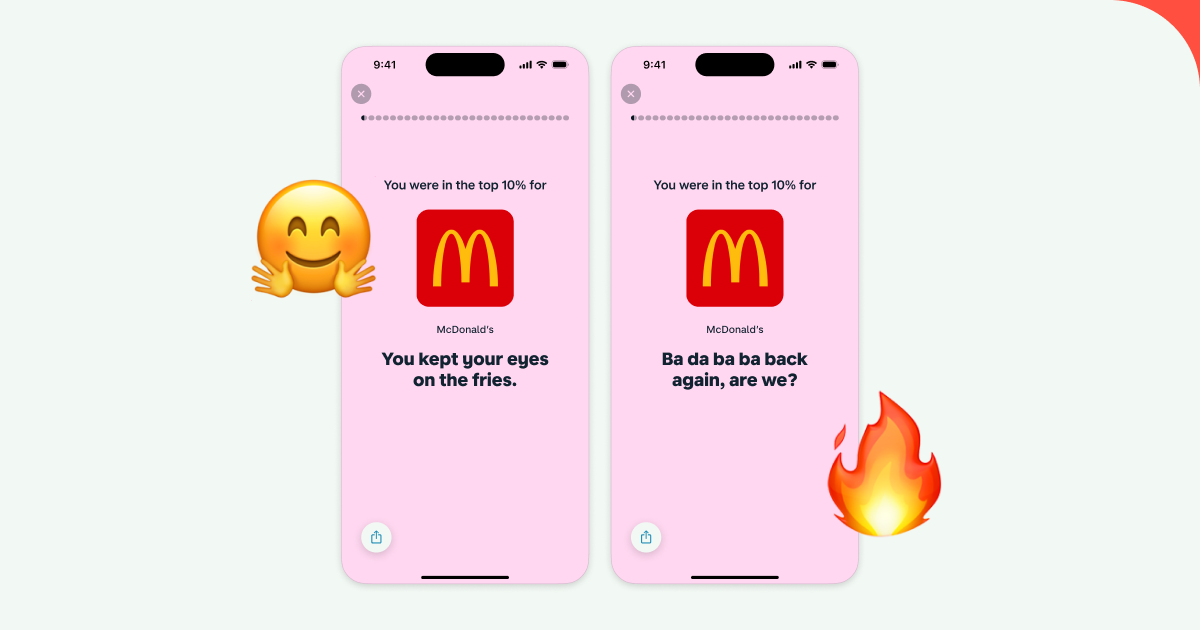
Monzo's two versions of the same merchant insight.
Letting people choose the tone gives the joke a better chance of landing. It also avoids guessing who would enjoy being teased about their spending.
A recap campaign needs enough history to say something worthwhile. For customers with limited activity, a brief useful summary may be better than a forced personality label. Keep sensitive transactions out of shareable content, and let the customer decide whether to share anything.
20. YNAB: stop target alerts when someone chooses to pause
Customers sometimes change their priorities. A reminder that ignores that decision can quickly become irritating.
YNAB lets customers snooze a target for the rest of the month. This stops its underfunded alerts until the target wakes up next month. The customer keeps the goal while temporarily changing what needs attention.
The same idea belongs in campaign rules. A paused savings goal should leave the contribution-reminder audience until the pause ends or the customer reactivates it.
The customer's decision changes whether the campaign runs. More detailed copy would not fix a message that should have been suppressed.
Build a personalized fintech campaign
Choose a situation you can identify accurately and a next step that helps the customer. Start with an explicit choice or a confirmed product event. These are usually easier to explain than a prediction about someone's circumstances.
Before writing, define the conditions that would change the message. For a category-reward campaign, that could look like this:
| Customer state | What to show | When to stop |
|---|---|---|
| Eligible, with no category selected | A short explanation and the available choices | A choice is saved or eligibility ends |
| Category selected, no reward yet | Confirmation of the selection and its actual limits | The information is already understood; avoid repeating it without a reason |
| Reward confirmed | The earned amount and relevant remaining allowance | Confirmation has been delivered |
| Monthly allowance exhausted | The used allowance and when it resets | The next period begins |
| Customer turned off promotional messages | No promotional reminder | They choose to opt in again |
Check the state again just before sending. Someone may have completed the action after the audience was selected. The destination matters as much as the notification: take them to the relevant payment, goal or offer with its current details.
Keep private financial detail off a lock screen unless the customer's settings allow it. You can still make a message specific enough to be useful without displaying a balance or naming a sensitive transaction.
Measure the effect of campaign personalization
Pick a result tied to the problem you are solving. A salary-sorting prompt should lead to a useful saved split. A changed-bill alert should help the customer review a charge. An informational payment confirmation can succeed without bringing them back into the app.
To test the value of personalization, compare eligible customers receiving the adapted campaign with comparable customers receiving the same campaign without that adaptation. Keep the offer and delivery conditions consistent unless those are what you are testing. A separate no-campaign group can help establish whether contacting people added value at all.
Follow the completed action and its later consequences. Watch for repeated dismissals or opt-outs that suggest the message is unwanted. If a campaign raises activity, use the economics of the action to work out whether the extra value covers its cost.
For a first campaign, choose the example where you already have reliable data and a useful destination. Then use the incentive campaign collection if a reward would help. The best reason to send the message should be clear before you add one.